
Torzon Market is an anonymous online marketplace that operates inside the Torzon darknet — that is, on the Tor network through onion addresses. The market trades goods and services that are restricted or illegal in most countries, which is why it works only through encrypted Tor connections and constantly changing Torzon link mirrors. Its own interface brands the project as active “since 2022”, and most public references date the market to that year.
This page is the starting point of a practical guide. Below are the answers to the questions people ask about Torzon Market most often: what kind of market it is, when it was founded, how it differs from other darknet markets, which payment methods it uses, how it protects user accounts and how its escrow model works. Each topic links to a separate article with a detailed answer.
One naming note: the misspelling Torzon Marketlpace — “marketplace” with a missing letter — appears in thousands of searches and means exactly the same thing as Torzon Market. This guide uses both forms so that searchers land on one consistent explanation, whatever they type.
Torzon Market onion mirrors
Checked 10 November 2026Three known onion addresses for Torzon Market. Open them in Tor Browser only — the addresses do not resolve in an ordinary browser. Start with the first one and move down the list if it does not answer.
- 1Torzon Market — primary mirror
torzonwhxa7cscybxwxjlsto2c5fna5745bzjyeyq3ztz7733hbgd3id.onionchecked first - 2Torzon Market — backup mirror 2
torzonccvmgcozkqhb6676bqbpft2rmfbjrssd4sjwtqd3cqrl2eraad.onion - 3Torzon Market — backup mirror 3
torzonny3nmufzgyfxpft3lyixwt2cvlmn44s6efikn5npjkhioypiyd.onion
Outside Tor a click copies the address to the clipboard instead of opening it. Verify every address against the verification handbook before entering credentials — clones are common in this niche.
All Torzon Market topics
Every question this guide answers, on one page. Follow a topic to the article that covers it in full.
Quick reference
- What it is
- Anonymous Tor marketplace for restricted goods and services
- Founded
- 2022, according to the market’s own branding
- Payments
- Bitcoin (BTC) and Monero (XMR) with account balances in EUR
- Account security
- Password login, captcha and optional PGP two-factor authentication
- Escrow
- Funds held by the market until the buyer confirms the order
- Access
- Tor onion addresses via rotating mirrors and link rotators
What is Torzon Market?
Torzon Market is a darknet marketplace — a trading platform reachable only through the Tor anonymity network. Like other markets in the Torzon darknet niche, it combines anonymous accounts, cryptocurrency payments and an escrow system so that buyers and sellers can trade without knowing each other’s real identities. The range of goods is typical for this segment: the largest category in public screenshots is drugs, followed by digital goods and counterfeit documents.
The market presents itself as a polished, modern platform: a clean layout, product search with filters, vendor pages, an internal messaging system and buyer protection through escrow. In practice this means Torzon Market works like a conventional e-commerce site, with the difference that all access goes through an onion address and all payments are made in cryptocurrency.
When was Torzon Market founded?
Public references and the market’s own branding point to 2022 as the founding year of Torzon Market: its welcome screen carries the tagline “since 2022”. There is no independently verified incorporation date — darknet markets do not publish one — so 2022 should be read as the year the project appeared in public sources, not as a legally registered founding date.
The dedicated article on the history of Torzon Market explains how researchers reconstruct such dates from dated screenshots, forum threads and archived Torzon link lists, and why different sources sometimes give conflicting years.
How does Torzon Market differ from other markets?
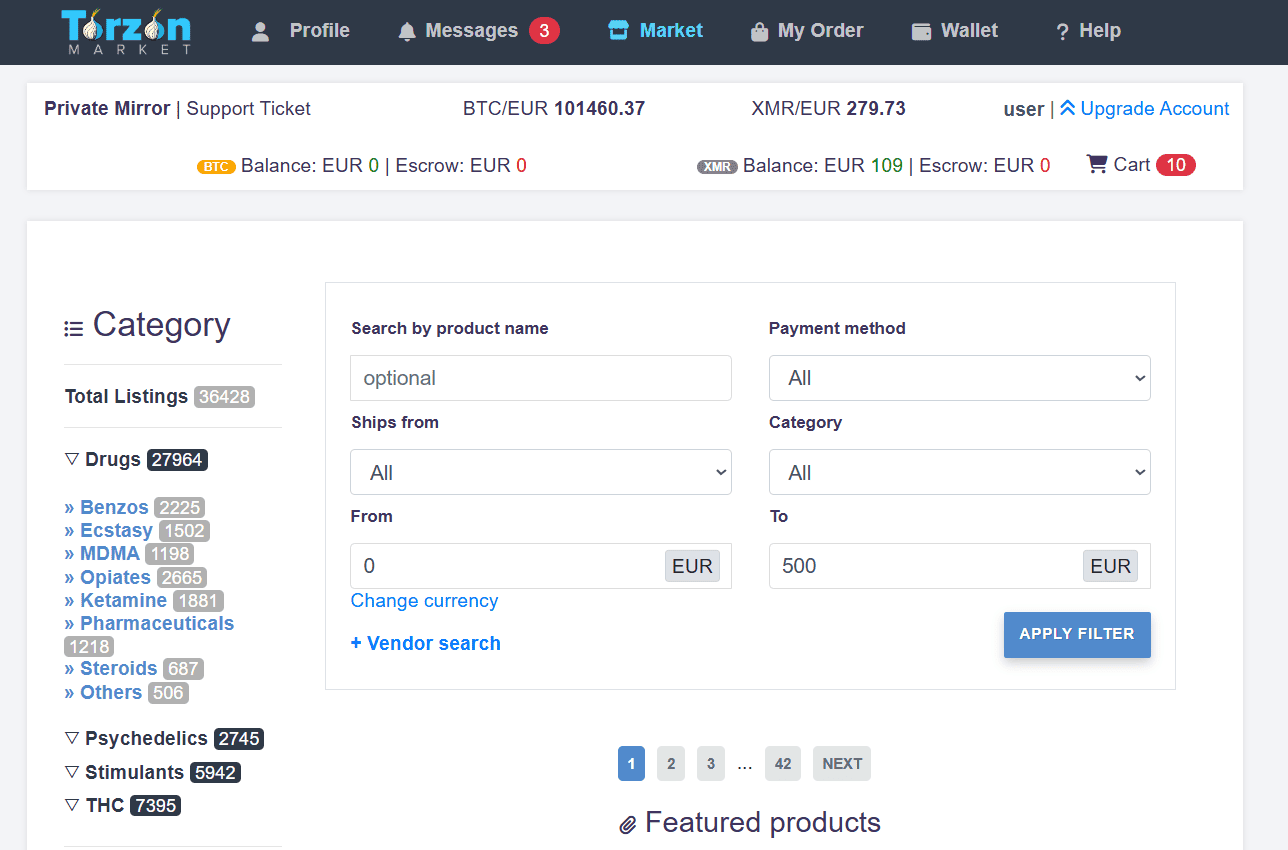
Compared with older darknet markets, Torzon Market bets on usability and privacy. Its interface resembles a conventional online shop more than a forum-style market: categories with live listing counters, a search with price and shipping filters, a shopping cart and an order dashboard. Public screenshots show more than 36,000 listings, which puts it among the larger markets in the Torzon darknet segment.
Three differences are most often mentioned in comparisons: a strong emphasis on Monero (XMR), which is harder to trace than Bitcoin; a mirror-rotator system that publishes fresh Torzon link addresses as old ones are blocked; and a relatively low barrier to entry for buyers, including an account-upgrade system rather than mandatory vendor bonds for ordinary users.
Which payment methods does Torzon Market use?
Torzon Market works only with cryptocurrency. The account panel in public screenshots shows balances in two coins: Bitcoin (BTC) and Monero (XMR), with amounts also displayed in euro equivalents for convenience. Bitcoin is the familiar option; Monero is the privacy-focused one — its transactions hide amounts and addresses on the blockchain by default, which is why the Torzon darknet community generally treats XMR as the safer choice.
Payments are not sent directly between buyer and seller. Each purchase moves coins into the market’s internal balance and then into escrow, where they stay until the order is completed. The payments article covers deposit limits, fees and the practical differences between paying with BTC and XMR.
How does Torzon Market protect user accounts?
Account protection on Torzon Market is built in layers. The basics are a username-and-password login plus a captcha that blocks automated brute-force attempts. The stronger layer is optional PGP two-factor authentication (2FA): after entering the password, the user must decrypt a random message with their private PGP key, which makes an account useless to an attacker even if the password leaks.
The security article explains how to enable 2FA, why the captcha on login pages is also a weak point (phishing copies replicate it), and what other habits — unique passwords, encrypted storage, checking the Torzon link signature — protect an account in the Torzon darknet environment.
How does the Torzon Market escrow model work?
Escrow is the core trust mechanism of Torzon Market. When a buyer pays, the coins are not released to the vendor immediately. They are held by the market in an escrow balance — the account panel in public screenshots shows separate “Balance” and “Escrow” lines in both BTC and XMR — and the vendor ships the goods knowing the money is locked.
When the buyer confirms receipt, the escrow is released to the vendor minus the market’s commission. If something goes wrong, the buyer opens a dispute and the market’s staff decide where the funds go. The escrow article describes the full cycle, the “finalize early” exception for trusted vendors and the cases in which escrow cannot protect the buyer.